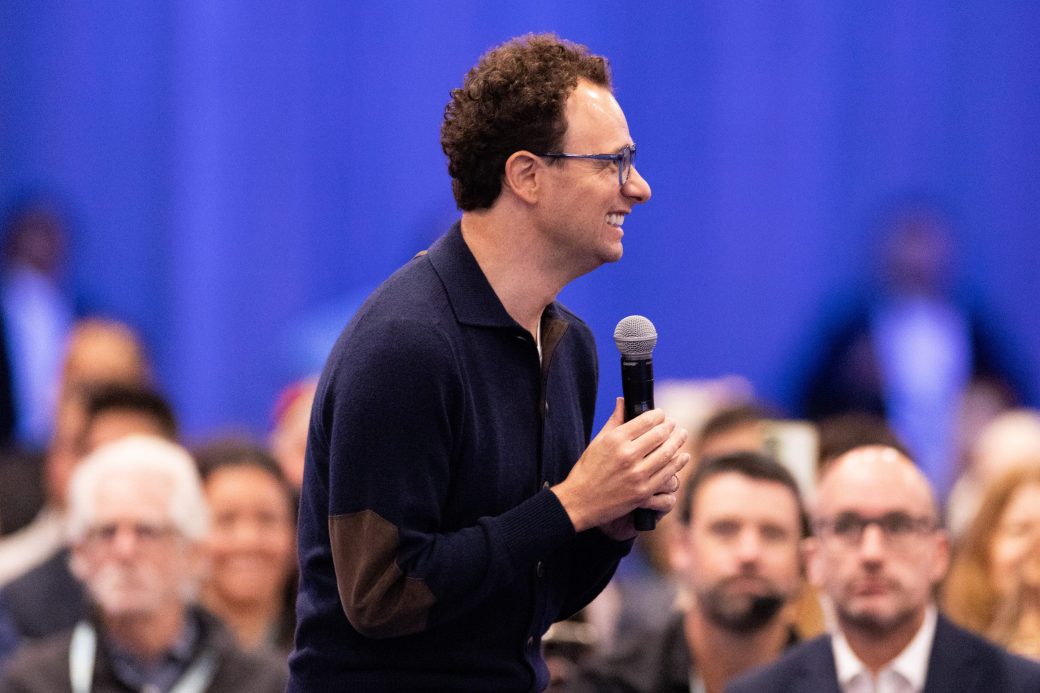
Anthropic plans to price its shares at $70 to $78, implying a valuation of $1.3 trillion, below earlier market expectations.
6:45 PMFortune111 stories from 23 sources
Supporting Articles
Anthropic plans to price its shares at $70 to $78, implying a valuation of $1.3 trillion, below earlier market expectations.
6:45 PMFortune
OpenAI’s third quarter revenue rose about 50% to $10 billion, but its operating loss widened to $10.9 billion. The results underscore the gap between rapid AI sales growth and the heavy costs required to build and run these systems.
8:22 PMEconomic Times
CoreWeave reported third quarter revenue above expectations and outlined $9 billion in planned prepayments. The financing plan strengthened investor confidence in the company’s ability to manage its debt burden.
6:27 AMMarketWatch
New York’s AI safety law is taking effect, requiring major developers including OpenAI and Anthropic to register, disclose safety practices, and report critical incidents. Companies that fail to comply could face fines.
3:52 PMTechCrunch
SoftBank reported a $7 billion loss, its first net loss in nearly two years, after writing down $3.7 billion tied to U.S. data-center projects and absorbing declines in AI-related valuations. Its shares fell as much as 11%.
7:30 PMBloomberg Markets
Australia has unveiled a new artificial intelligence regulator following a breach involving OpenAI. The government is also considering criminal penalties for companies whose models engage in harmful conduct.
6:01 AMThe New York Times
OpenAI is launching Businesses in ChatGPT, a beta suite that lets companies manage profiles, measure customer engagement, and deploy AI agents to interact with potential customers. The tools give businesses a formal way to build a presence inside ChatGPT.
7:44 PMPYMNTS
Anthropic is launching workplace applications that embed its AI into everyday business workflows. The move expands its competition with Microsoft and Google as the company prepares for a major initial public offering.
4:10 PMPYMNTSSummary
Anthropic plans to price its shares at $70 to $78, implying a valuation of $1.3 trillion, below earlier market expectations.
The lower pricing resets expectations for Anthropic and reduces the potential upside for existing shareholders
Unlock the full First Pass Analysis to get a better understanding of why this story mattersWhy it matters
Anthropic’s pricing will test whether public investors still reward leading AI companies with exceptionally high valuations.
5 stories · 5 sources
Summary
OpenAI’s third quarter revenue rose about 50% to $10 billion, but its operating loss widened to $10.9 billion. The results underscore the gap between rapid AI sales growth and the heavy costs required to build and run these systems.
Revenue growth is not yet translating into profitability, as OpenAI’s losses now exceed its quarterly
Unlock the full First Pass Analysis to get a better understanding of why this story mattersWhy it matters
OpenAI’s results reinforce that AI leadership still requires enormous spending, making future funding and profitability tests more consequential.
Summary
CoreWeave reported third quarter revenue above expectations and outlined $9 billion in planned prepayments. The financing plan strengthened investor confidence in the company’s ability to manage its debt burden.
The key shift is that CoreWeave paired stronger operating results with a clearer path to
Unlock the full First Pass Analysis to get a better understanding of why this story mattersWhy it matters
CoreWeave is showing that AI infrastructure companies can win back investors by improving both growth and debt discipline.
2 stories · 2 sources
Summary
New York’s AI safety law is taking effect, requiring major developers including OpenAI and Anthropic to register, disclose safety practices, and report critical incidents. Companies that fail to comply could face fines.
The law turns frontier-model safety from a voluntary disclosure exercise into a state compliance obligation.
Unlock the full First Pass Analysis to get a better understanding of why this story mattersWhy it matters
The rules create an early test of whether state governments can impose practical safety standards on the largest AI labs.
Summary
SoftBank reported a $7 billion loss, its first net loss in nearly two years, after writing down $3.7 billion tied to U.S. data-center projects and absorbing declines in AI-related valuations. Its shares fell as much as 11%.
The writedown shows that SoftBank's AI exposure is producing immediate balance-sheet risk, not just paper
Unlock the full First Pass Analysis to get a better understanding of why this story mattersWhy it matters
SoftBank's losses offer a market test of whether AI infrastructure valuations can withstand weaker financing and repricing.
Summary
Australia has unveiled a new artificial intelligence regulator following a breach involving OpenAI. The government is also considering criminal penalties for companies whose models engage in harmful conduct.
Australia is moving from voluntary oversight toward direct accountability for AI developers. If criminal liability
Unlock the full First Pass Analysis to get a better understanding of why this story mattersWhy it matters
The proposal could push AI governance beyond transparency rules and toward legal responsibility for the real-world behavior of deployed models.
Summary
OpenAI is launching Businesses in ChatGPT, a beta suite that lets companies manage profiles, measure customer engagement, and deploy AI agents to interact with potential customers. The tools give businesses a formal way to build a presence inside ChatGPT.
OpenAI is turning ChatGPT from a standalone assistant into a commercial discovery and customer-service channel.
Unlock the full First Pass Analysis to get a better understanding of why this story mattersWhy it matters
The initiative could make ChatGPT a new customer-acquisition layer and shift some search and commerce activity away from traditional websites.
Summary
Anthropic is launching workplace applications that embed its AI into everyday business workflows. The move expands its competition with Microsoft and Google as the company prepares for a major initial public offering.
Anthropic is moving up the stack from model supplier to enterprise software provider, putting it
Unlock the full First Pass Analysis to get a better understanding of why this story mattersWhy it matters
The office suite could determine whether Anthropic captures end-user spending or remains dependent on larger platforms for distribution.
A curated list of other prominent stories from this day.

Microsoft is rolling out Automatic Super Resolution, its answer to Nvidia’s DLSS, on the Xbox Ally X, Xbox Ally X20, and select Windows Copilot Plus PCs. The upscaling tech can boost image quality and performance while the devices are running in handheld mode, with several new features arriving alongside the wider release.
7:34 PMThe Verge
Higharc and ECI have launched an integration connecting Higharc's 3D home design and option-pricing tools with ECI's MarkSystems ERP workflows. The link is designed to reduce duplicate data entry and errors for production homebuilders.
7:24 PMHousing Wire
A spy scandal has weakened Jensen Huang's position and damaged his influence over U.S. AI policy. Even if he remains Nvidia's CEO, his role as a prominent opponent of tighter export controls and advocate for open-source AI has been diminished.
7:12 PMFortuneAI could reduce banks' cost bases by 20% or more, according to McKinsey. Most banks have so far used it mainly to improve individual employee productivity, with little measurable effect on overall costs.
7:01 PMFinextra
Lowes Foods says AI is already shaping shopping behavior and cites a projection that 80% of shoppers will interact with AI by 2030. The discussion focuses on how retailers may need to adapt as consumers use AI during the shopping process.
6:06 PMConsumer Goods Technology
AMD shares have lost momentum as investors assess whether Nvidia's troubles will create durable gains for its rival. The central question is whether customers will actually change suppliers rather than simply shift capital between stocks.
5:37 PMMarketWatch
Oura said it will acquire Counsel Health for $625 million after adding the startup's AI chatbot to its app earlier this year. Counsel describes its product as an AI-native primary care service that uses users' health data to generate responses and insights.
4:40 PMThe Verge
Spirit's proposed $10 million sale to Google would provide about 1.9 billion emails and 30 million lines of code for AI training. Unions secured protections requiring employee data to be removed before the information is transferred.
2:47 PMSkift
Big Walk is heading into awards season with an unexpected problem: members of the IGF jury say they will not vote for games that use AI in any form. That hardline position could put the game's recognition at risk and reignite arguments over where the industry should draw the line.
2:25 PMPolygon
Several AI agents produced similar estimates for a home's value, but matching outputs do not prove that the estimates are accurate. The estimates may reflect shared market assumptions rather than independent analysis of comparable sales.
12:03 PMHousing Wire
The article presents a framework for deciding when switching between AI models creates enough practical value to justify the disruption. It focuses on an industry where competing systems repeatedly overtake one another without establishing durable superiority.
11:28 AMChief Executive
Adobe announced new AI agent features across its creative products, including tools designed to automate parts of creative workflows. Executives also stressed that users can choose whether and how to incorporate AI into their work.
9:53 AMVariety
Goldman Sachs projects Anthropic's revenue will surpass $600 billion by 2030, implying roughly 130-fold growth from current levels. The forecast also expects the AI company to become cash-flow positive by the end of the decade.
9:52 AMFinancial TimesIndia's data-center capacity could grow nearly fivefold to about 7.5 GW by March 2030, supported by more than ₹3 lakh crore in investment. The editorial argues that governments should establish who will fund the electricity, water, grid, and other infrastructure required before allocating land for AI facilities.
9:14 AMThe Property TimesAmazon is considering deploying 20,000 pairs of smart glasses to delivery drivers by 2027. More than 300 delivery service partners and hundreds of drivers have already tested the devices.
9:00 AMWWD
Hollywood's adoption of artificial intelligence is already threatening storyboard artists, whose drawings translate a director's early ideas into visual plans. The article examines what could be lost as filmmakers use AI in preproduction and imagines a wider industry shaped by machine-generated stories, actors, and images.
8:00 AMThe Guardian Art and Design
Researchers argue that AI-generated health advice can be factually correct while still pushing people toward less healthy behavior. The concern centers on how people interpret and act on information, not only on whether the information is accurate.
4:30 AMStat NewsSummary
Microsoft is rolling out Automatic Super Resolution, its answer to Nvidia’s DLSS, on the Xbox Ally X, Xbox Ally X20, and select Windows Copilot Plus PCs. The upscaling tech can boost image quality and performance while the devices are running in handheld mode, with several new features arriving alongside the wider release.
This gives Microsoft’s handheld push a useful graphics upgrade without asking developers to rebuild their
Unlock the full First Pass Analysis to get a better understanding of why this story mattersWhy it matters
Handheld players could get smoother games and better visuals without sacrificing battery life or performance.
Summary
Higharc and ECI have launched an integration connecting Higharc's 3D home design and option-pricing tools with ECI's MarkSystems ERP workflows. The link is designed to reduce duplicate data entry and errors for production homebuilders.
The integration shifts more of the homebuilding process into a connected design-to-ERP workflow, reducing the
Unlock the full First Pass Analysis to get a better understanding of why this story mattersWhy it matters
Tighter software integration could lower administrative costs and make digital workflow control a competitive factor for large builders.
Summary
A spy scandal has weakened Jensen Huang's position and damaged his influence over U.S. AI policy. Even if he remains Nvidia's CEO, his role as a prominent opponent of tighter export controls and advocate for open-source AI has been diminished.
The immediate consequence is political rather than operational: Nvidia may retain its leader while losing
Unlock the full First Pass Analysis to get a better understanding of why this story mattersWhy it matters
Huang's reduced policy influence could accelerate stricter U.S. controls on advanced chips and AI models.
Summary
AI could reduce banks' cost bases by 20% or more, according to McKinsey. Most banks have so far used it mainly to improve individual employee productivity, with little measurable effect on overall costs.
The main gap is organizational, not technological: banks have not yet redesigned processes, staffing models,
Unlock the full First Pass Analysis to get a better understanding of why this story mattersWhy it matters
The banking AI race is shifting from experimentation to execution, with cost structure becoming the clearest measure of success.
Summary
Lowes Foods says AI is already shaping shopping behavior and cites a projection that 80% of shoppers will interact with AI by 2030. The discussion focuses on how retailers may need to adapt as consumers use AI during the shopping process.
The important change is that AI may become an intermediary between shoppers and retailers, influencing
Unlock the full First Pass Analysis to get a better understanding of why this story mattersWhy it matters
Retailers may soon compete not only for shoppers, but also for placement inside the AI systems guiding them.
Summary
AMD shares have lost momentum as investors assess whether Nvidia's troubles will create durable gains for its rival. The central question is whether customers will actually change suppliers rather than simply shift capital between stocks.
AMD can benefit from Nvidia's disruption only if customers adopt its chips, not merely if
Unlock the full First Pass Analysis to get a better understanding of why this story mattersWhy it matters
AMD's opportunity depends on converting Nvidia's weakness into customer commitments, a much harder test than attracting speculative capital.
Summary
Oura said it will acquire Counsel Health for $625 million after adding the startup's AI chatbot to its app earlier this year. Counsel describes its product as an AI-native primary care service that uses users' health data to generate responses and insights.
Oura is consolidating the AI care product it had been testing inside its wearable ecosystem.
Unlock the full First Pass Analysis to get a better understanding of why this story mattersWhy it matters
The deal pushes Oura deeper into medical decision support, where clinical risk and regulation rise alongside the commercial opportunity.
Summary
Spirit's proposed $10 million sale to Google would provide about 1.9 billion emails and 30 million lines of code for AI training. Unions secured protections requiring employee data to be removed before the information is transferred.
The agreement shows that valuable training data can be sold cheaply when privacy and labor
Unlock the full First Pass Analysis to get a better understanding of why this story mattersWhy it matters
The deal tests how companies can monetize large data archives while meeting privacy obligations to workers.
Summary
Big Walk is heading into awards season with an unexpected problem: members of the IGF jury say they will not vote for games that use AI in any form. That hardline position could put the game's recognition at risk and reignite arguments over where the industry should draw the line.
The debate is quickly moving beyond how much AI a game uses. For some judges,
Unlock the full First Pass Analysis to get a better understanding of why this story mattersWhy it matters
Awards rules around AI could shape how studios build, market, and judge games going forward.
Summary
Several AI agents produced similar estimates for a home's value, but matching outputs do not prove that the estimates are accurate. The estimates may reflect shared market assumptions rather than independent analysis of comparable sales.
Agreement among AI valuation tools is weak evidence when the systems draw on similar data,
Unlock the full First Pass Analysis to get a better understanding of why this story mattersWhy it matters
AI consensus can create false confidence in property values without proving that any estimate is correct.
Summary
The article presents a framework for deciding when switching between AI models creates enough practical value to justify the disruption. It focuses on an industry where competing systems repeatedly overtake one another without establishing durable superiority.
The key shift is that model leadership is becoming temporary, so companies cannot treat a
Unlock the full First Pass Analysis to get a better understanding of why this story mattersWhy it matters
Rapidly changing model performance turns AI procurement into an ongoing operating decision rather than a one-time platform choice.
Summary
Adobe announced new AI agent features across its creative products, including tools designed to automate parts of creative workflows. Executives also stressed that users can choose whether and how to incorporate AI into their work.
Adobe is expanding AI from an optional feature into a layer across its product suite
Unlock the full First Pass Analysis to get a better understanding of why this story mattersWhy it matters
Adobe is testing whether AI can become central to creative software without alienating the professionals who depend on it.
Summary
Goldman Sachs projects Anthropic's revenue will surpass $600 billion by 2030, implying roughly 130-fold growth from current levels. The forecast also expects the AI company to become cash-flow positive by the end of the decade.
The forecast assumes extraordinary expansion in enterprise AI adoption, pricing and usage, not merely continued
Unlock the full First Pass Analysis to get a better understanding of why this story mattersWhy it matters
A $600 billion forecast shows how aggressively markets are pricing AI's future commercial scale.
Summary
India's data-center capacity could grow nearly fivefold to about 7.5 GW by March 2030, supported by more than ₹3 lakh crore in investment. The editorial argues that governments should establish who will fund the electricity, water, grid, and other infrastructure required before allocating land for AI facilities.
The planned expansion shifts major costs onto public infrastructure unless contracts assign them clearly to
Unlock the full First Pass Analysis to get a better understanding of why this story mattersWhy it matters
India's AI buildout will be judged not only by capacity added, but by whether taxpayers and communities are left paying for its basic operating needs.
Summary
Amazon is considering deploying 20,000 pairs of smart glasses to delivery drivers by 2027. More than 300 delivery service partners and hundreds of drivers have already tested the devices.
Amazon is moving wearable AI from pilot projects toward operational scale in last-mile delivery. The
Unlock the full First Pass Analysis to get a better understanding of why this story mattersWhy it matters
A large rollout would make smart glasses a workplace management tool, not just a consumer gadget.
Summary
Hollywood's adoption of artificial intelligence is already threatening storyboard artists, whose drawings translate a director's early ideas into visual plans. The article examines what could be lost as filmmakers use AI in preproduction and imagines a wider industry shaped by machine-generated stories, actors, and images.
The immediate shift is not fully automated filmmaking but the erosion of behind-the-scenes work that
Unlock the full First Pass Analysis to get a better understanding of why this story mattersWhy it matters
AI is reshaping film labor before it replaces stars or screenwriters, making creative ownership an immediate workplace issue rather than a distant cultural debate.
Summary
Researchers argue that AI-generated health advice can be factually correct while still pushing people toward less healthy behavior. The concern centers on how people interpret and act on information, not only on whether the information is accurate.
Accuracy is not a sufficient safety standard for health AI. Advice can increase anxiety, encourage
Unlock the full First Pass Analysis to get a better understanding of why this story mattersWhy it matters
Health AI could cause harm even without giving false information if its advice changes behavior in damaging ways.
Make it yours
Pick your topics, set your cadence, and receive your personalized First Pass in your inbox. It’s that simple!